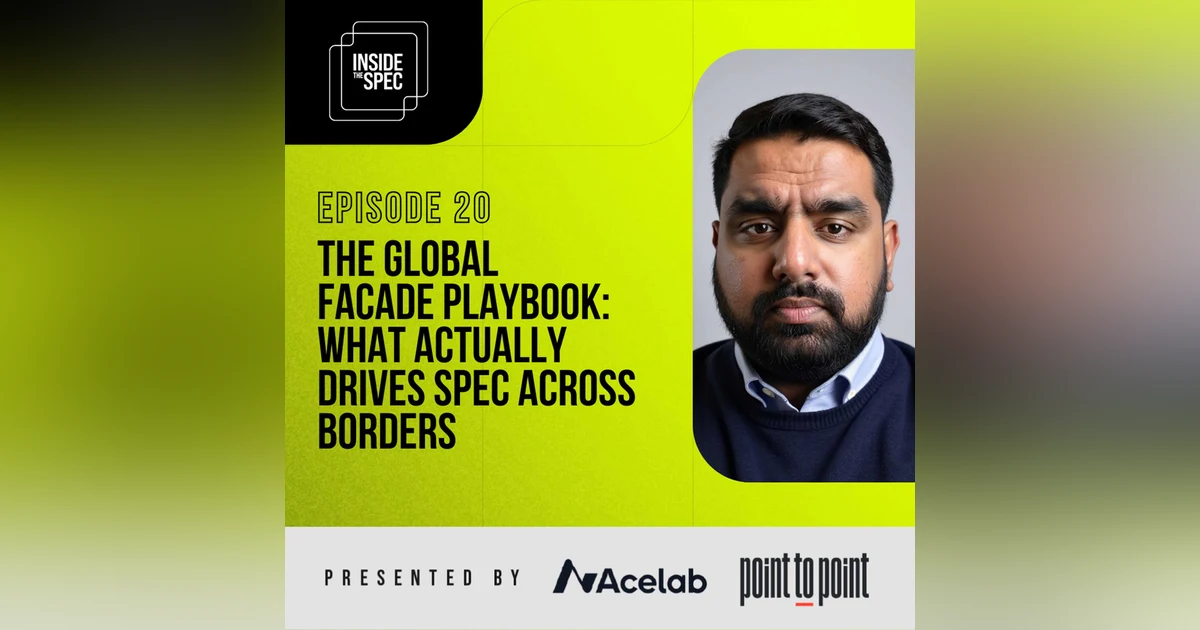
Episode 20: The Global Façade Playbook: What Actually Drives Spec Across Borders


Summary
Ahad Ahmed, director at Zak Exhibitions and Conferences, joins Megan Kacvinsky and Vardhan Mehta to explore how facade specification decisions are shaped across global markets. Drawing on 225 editions of Zak World of Facades in 51 countries, Ahad discusses event strategy, sponsor ROI, code and carbon pressures, EPDs, digital specification, AI, and the future of facade-focused collaboration.
Key Insights
- A tightly curated audience can change the value of an industry event. Zak World of Facades uses an invite-only model in which manufacturers participate as sponsors while the broader audience is selected from architects, engineers, and other specifiers.
- Event ROI depends on more than who is in the room. Ahad emphasizes that manufacturers must send the right people, prepare for the local market, and proactively start conversations rather than waiting behind a tabletop display.
- Facade conversations are increasingly driven by cost, carbon, safety, and code. Ahad points to fire performance, embodied carbon, bird-friendly requirements, and regional code changes as forces reshaping what specifiers need to understand.
- EPDs are becoming an important part of manufacturer accountability. They give specifiers visibility into raw materials, manufacturing processes, energy sources, transportation, and other factors tied to embodied carbon.
- The value of a product presentation is shifting from simply introducing something new to showing how an existing product can be used more effectively with current tools, workflows, and design expectations.
- Digital specification is becoming a competitive requirement. Manufacturers need products and data that can integrate more easily into BIM, visualization, and emerging AI-driven design workflows.
- Global specification is not one-size-fits-all. Language, culture, code, market maturity, and local expectations can dramatically change how manufacturers should approach architects and engineers in different regions.
- The next generation of facade conversations will extend beyond design and construction into operations, maintenance, access, data, and building regeneration.
Practical Takeaways for Manufacturers
- Treat conference participation as a sales strategy, not a booth assignment. Select representatives who can recognize priority contacts, start conversations, and connect product knowledge to the needs of the people in the room.
- Prepare for the market you are entering. Account for local language, codes, cultural expectations, and specification practices before sending a team to a regional or international event.
- Train teams to lead with relevance rather than novelty. Even when the product itself is established, manufacturers can create value by showing new applications, visualization methods, digital tools, or specification workflows.
- Invest in credible sustainability documentation, including EPDs where appropriate, and make sure teams can explain what the data means for embodied carbon and project decisions.
- Track code changes that affect the building envelope, including fire, carbon, bird-friendly design, and other facade-related requirements, so sales and marketing teams can educate rather than react.
- Make digital product information easy to use in the tools specifiers already rely on. BIM-ready content, visualization tools, plugins, and structured specification data can make a product easier to evaluate and incorporate into design.
- Evaluate event success by the quality and number of meaningful conversations, not attendance alone. Follow-up processes should be designed to turn those conversations into ongoing relationships.
- Look beyond new construction. Maintenance, facade access, renovation, operations data, and regeneration are becoming increasingly important parts of the building-envelope conversation.
About the Guest
Ahad Ahmed is a director at Zak Exhibitions and Conferences, the organization behind Zak World of Facades, a global conference series focused on facade design, engineering, and construction. Since the series began in 2012, it has grown to 225 editions across 51 countries. Ahad has helped expand the platform from India into markets around the world, creating focused forums that connect facade manufacturers with architects, engineers, contractors, and other specifiers.
Quotable Moments
- “It’s always about the conversation. You have a conversation and then the conversation leads to something.”
- “Don’t sit behind the table, stand in front of the table.”
- “Digital specification, I think, is the next big thing.”
Next Steps for Manufacturers
Use this episode to reassess how your organization shows up in front of specifiers. Audit your event strategy, sustainability documentation, code knowledge, and digital specification tools, then identify where you are creating friction for architects and engineers. Manufacturers that make conversations easier, information more credible, and products simpler to evaluate will be better positioned as facade decisions continue to evolve.